
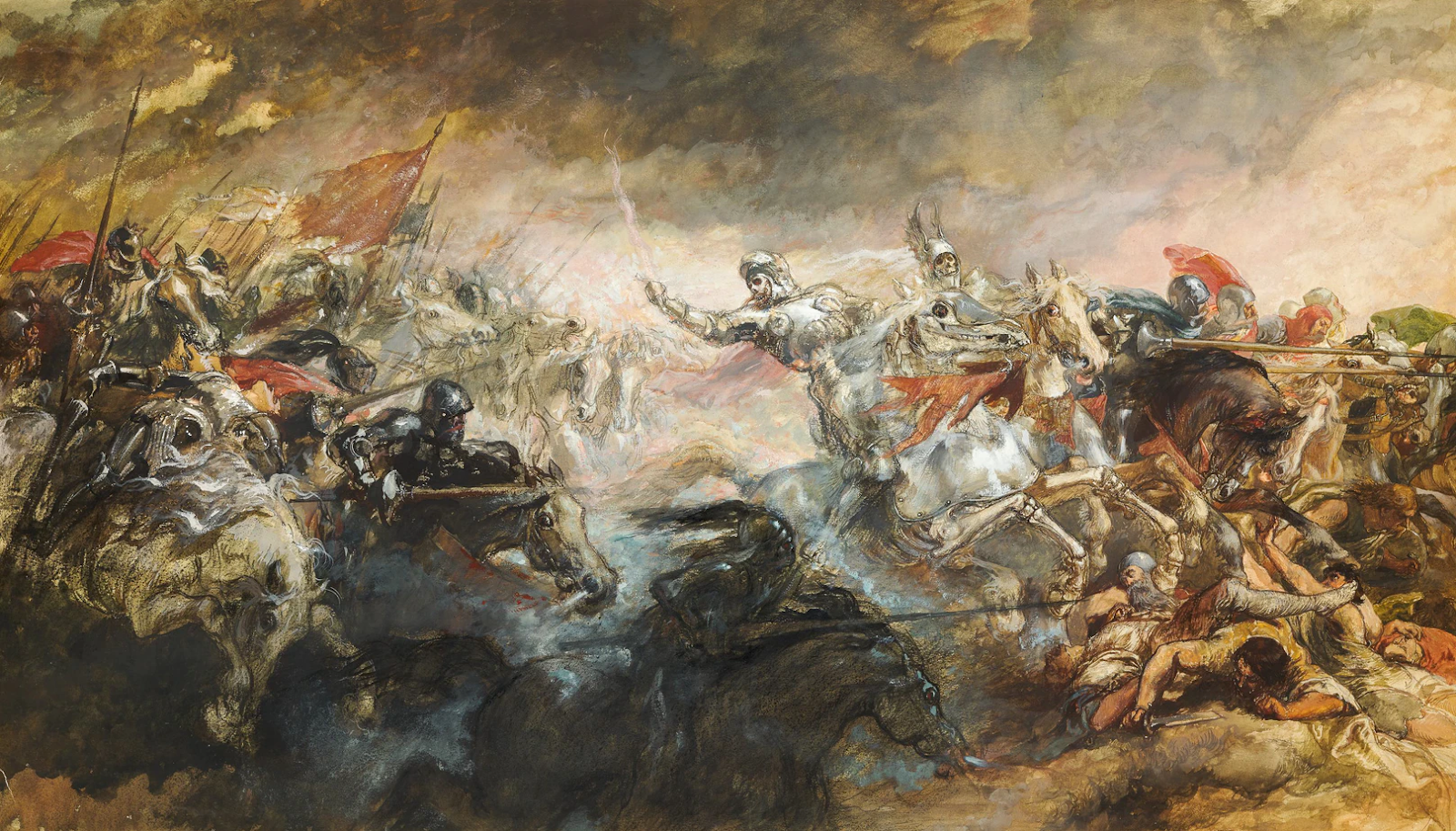
“Put not your trust in princes, nor
in the son of man, in whom there is no help.”
Psalm 146:3
(Here is the
video version of this talk, here).
Over the
last week or two I have written a lot about why we should not intervene in
foreign wars. Some people might ask why I care so much, the bombs are over
there, not over here, who cares what our government does overseas, it’s not our
problem…this is precisely the problem. We are at ease like fattened calves
enjoying the ride on the trailer to the slaughterhouse. Sure, one way to
approach that is to enjoy the nice view on the ride, another way to look at
that is: oh no, things are about to get really different and messy. In this
context we need a deeper understanding of how God interacts with nations,
because nations that are at ease in wickedness will be judged;
“1 Woe to those who are at ease in Zion, and to
those who feel secure on the mountain of Samaria, the notable men
of the first of the nations, to whom the house of Israel comes!
2 Pass over to Calneh, and see, and from there go to Hamath
the great; then go down to Gath of the Philistines. Are you better
than these kingdoms? Or is their territory greater than your territory,
3 O you who put far away the day of disaster and bring near the seat
of violence? 4 “Woe to those who lie on beds of ivory and
stretch themselves out on their couches, and eat lambs from the flock and
calves from the midst of the stall, 5 who sing idle songs to the sound of
the harp and like David invent for themselves instruments of music, 6 who
drink wine in bowls and anoint themselves with the finest oils, but
are not grieved over the ruin of Joseph! 7 Therefore they shall now be the
first of those who go into exile, and the revelry of those who stretch
themselves out shall pass away” (Amos 6:1-7).
Australian’s
care more about their next leisure activity than the fact that our nation just
declared war by giving arms to a foreign nation at war. No war has ever seriously affected the Australian mainland since WW2 and even the attacks by
Japan at the time of that war were relatively minor compared to what was
happening in most of the other theatres of war.[1]
Aussies culturally think of war as something “over there”, something for the
barbarian lands, where we go to establish justice and freedom. This view that
war is “over there” has helped make us a nation that cares more about getting the
boat out to go fishing, or the smoker out to slow cook a brisket, than telling
our leaders to stop engaging in foreign wars. Like ancient Israel, we are a nation
at ease in a time before the judgement comes.
In some of
my previous pieces on war, I noted three pillars of non-interventionism: sovereignty of government,
sovereign borders and rejecting alliances. Some people really struggled with
the concept of “not going down to Egypt” meaning: alliances are always to be
avoided. To be fair, it is understandable why some people will struggle with
this, because I am challenging what is essentially a well establish behaviour of
nations. To say we should avoid alliances sits in stark contrast to how we
think about international relations. We think it is good and decent and
necessary to have military alliances with similar nations, so we are ready for
whatever wars come. Most Christians can agree alliances are dangerous, and most
should be avoided, and not interfering in most wars is wise. But they can’t
handle the idea of this not going far enough, they struggle with the idea that
we should never have military alliances. So, what I want to do in this piece is
show how central this theme is to the Old Testament and that it is carried into
the New Testament. You will see by the end of this argument just how powerfully
this theme is backed up in the Scriptures.
Do Not Go
Down To Egypt
I already
explored this in more detail in a previous piece, but there are a few more
things to be said. Isaiah says also this about alliances;
“30 Ah, stubborn children,” declares the Lord, “who carry out
a plan, but not mine, and who make an alliance, but not of my Spirit, that they
may add sin to sin; 2 who set out to go down to Egypt, without asking for my
direction, to take refuge in the protection of Pharaoh and to seek shelter in
the shadow of Egypt! 3 Therefore shall the protection of Pharaoh turn to your
shame, and the shelter in the shadow of Egypt to your humiliation” (Isa.
30:1-3).
In Scripture
building military alliances is idolatry. Straight up. This is how it is
consistently referred to. It is important that some of these references regard
Egypt, the dominant power for Israel to rely on. If you are going to make
alliances, you make them with the strongest possible partners and even this was
condemned. But the ESV notes the words translated “who make an alliance” here
means “who weave a web”. This has within it the intrinsic scheming that
accompanies making foreign alliances, something the Bible outright condemns (Ps
2:1-3).
The KJV,
however, reads this passage to mean, “that cover with a covering, but not of my
spirit”. This reading of the Hebrews words still has the meaning of making alliances
but is built upon the root concept “to pour out” or make a “libation”[2].
This reading has in view the concept of the rituals of making an alliance with
a foreign nation. “Again, this act would constitute rebellion against Yahweh,
for it would involve recognition, if not worship, of Egyptian gods.”[3]
So, explicitly,
and clearly, the concept of alliances in the Bible is rebuked from the outset. Depending
on how you interpret the words in this passage they either carry the idea of
scheming like the wicked pagan nations or covering your nation with the
protection of foreign powers instead of God, just like a pagan nation. You
don’t even need an understanding of Hebrew to glean this meaning, because the
plain text of Isaiah 30-31 clearly frames trusting in alliances as idolatry.
Hosea says
essentially the same thing;
“8 Israel is swallowed up; already they are among the nations
as a useless vessel. 9 For they have gone up to Assyria, a wild donkey
wandering alone; Ephraim has hired lovers. 10 Though they hire allies among the
nations, I will soon gather them up. And the king and princes shall soon writhe
because of the tribute” (Hos. 8:8-10).
Those
familiar with the Old Testament language of idolatry know that what Hosea is
saying here is that Israel has committed idolatry, spiritual adultery, by
hiring foreign nations as allies. Not only is this sinful, and condemned here,
as in Isaiah, but Hosea notes how allying with other nations had ruined Israel,
taking away its distinctiveness among the nations, and enslaved it to foreign
tribute. Alliances fail, they corrupt your nation, they come with great cost,
and they make you like the pagan idolatrous schemers around you.
This is not
just a warning for Israel either, “Turn to him from whom people have deeply
revolted, O children of Israel” (Isa. 31:6). Alliances are not ok for pagan
nations, but a sign of their wickedness, and why they have so many troubles.
This is a warning for God’s people, and all people to turn and trust in God,
not alliances. The pagan nations rely on alliances and are constantly ruined
because of this. This is a deep and consistent theme in the Bible, going all
the way back to the founder of God’s people, Abraham.
Abram and
the Men of His House
There is a
remarkable passage in Genesis 14 which mentions Abram and his allies. But if
you just stop at this surface glance you will miss how this passage powerfully
teaches us not to rely on alliances.
The context
of the passage is a war between two alliances of kings. One led by Chedorlaomer
and the other by the king of Sodom. The allies of Chedorlaomer defeat the king
of Sodom and his allies, who flee, and in the process Abram’s nephew lot is
captured (vv.8-12). This is where Abram’s allies are now mentioned, “13 Then
one who had escaped came and told Abram the Hebrew, who was living by the oaks
of Mamre the Amorite, brother of Eshcol and of Aner. These were allies of
Abram.” Someone escapes and comes and tells Abram about what has
transpired. Abram is currently staying near his allies, likely this escapee is
related to these allies, or maybe Lot and his household. So, what happens next?
This is
where you would expect the captain to round up his allies, gather as large an
army as he can, and lead them in battle against the five victorious kings. But
an alliance of kings has already failed. What does Abram then do?
“14 When Abram heard that his kinsman had been taken captive,
he led forth his trained men, born in his house, 318 of them, and went in
pursuit as far as Dan. 15 And he divided his forces against them by night, he
and his servants, and defeated them and pursued them to Hobah, north of
Damascus” (Gen. 14:14-15).
Abram did
not round up his allies, he rounded up the men of his own house. This is
remarkable because there is a clear contrast between his behaviour and that of
the kings on either side of the previous battle. The kings gathered alliances
and were defeated, and one of those alliances was defeated by a man with the
men of his household, his servants, born and trained in his house. Genesis is
careful to note this, and then repeat this, so we know Abram did not rely on
alliances.
This is not
missed by the ancient witnesses, the righteous priest of God in that region
notes;
“18 And Melchizedek king of Salem brought out bread and wine.
(He was priest of God Most High.) 19 And he blessed him and said, “Blessed be
Abram by God Most High, Possessor of heaven and earth; 20 and blessed be God
Most High, who has delivered your enemies into your hand!” (Gen. 14:18-20).
Abram’s
refusal to rely on allies shines light on the God who gave Abram the victory.
Abraham here sets the model for a righteous people: trust in God, not in
alliances. To drive this message home Abram refuses to keep any of the loot for
himself but only accepts what is given to his men, and the men who were owed
back their possession, such as his allies.[4]
The passage is very clear to note Abram relied on the men of his own house and
God, not these allies.
There is
practical wisdom for this as well. Alliances built by foreign cultures are
inherently unstable and fragile. Many examples can be given, but anyone
familiar with the famous account of the Iliad will know that Homer goes out of
his way to note that the allies of the Trojans spoke many languages, and the
Greeks were united in their common language and culture. This gave the Greeks a
definite advantage on the battlefield, because just from the perspective of
passing along commands, there was less difficultly. Managing alliances is
tricky, relying on the men of your own house, or in other words your own people,
and your God, is far wiser.
Not
Allowed to Marry Foreign Women
Not only is
relying on the men of your own people wise, but so is marrying the women of
your own house. The Old Testament had very strict rules around who the
Israelites could marry. If you do not understand how foreign relations worked
in the ancient world, then you will miss some of the significance of what God
is saying with these rules. Deuteronomy 7:3-5 notes why the Israelites should
not marry the women from the nations surrounding them, when they take the land
of Canaan;
“3 You shall not intermarry with them, giving your daughters
to their sons or taking their daughters for your sons, 4 for they would turn
away your sons from following me, to serve other gods. Then the anger of the
Lord would be kindled against you, and he would destroy you quickly. 5 But thus
shall you deal with them: you shall break down their altars and dash in pieces
their pillars and chop down their Asherim and burn their carved images with
fire.”
Foreign
women will lead your men astray. Most Christians understand the individual
aspect of this warning. Don’t marry a foreign woman today, for Christians,
means don’t marry an unbeliever. They understand the application for Israelites
was that they were not to allow the influence of foreign gods into their
nation. This is why Boaz did not sin by marrying Ruth, because Ruth had
renounced her foreign gods and proved her dedication to Yahweh through her
righteous living. But there was more to this rule than just this.
In the
ancient world, indeed, in Royal circles until very recently, it was customary
for alliances to be made by marrying the daughter of a king or noble to another
king or noble. This had the effect of cementing the closeness of the
relationship between the two nations. But it also had the effect of allowing
the foreign nations to influence each other with their cultures. If you read
Bede’s ecclesiastical history you will see the Roman Church used this as a
strategy to convert pagan kings in Anglo-Saxon England. But ancient peoples did
this with their various pagan ideologies as well. Which is why marrying foreign
women was forbidden, it was to protect Israel from such influence and stop
foreign alliances, causing Israel to be caught up in foreign agendas.
The Kings of
Israel often disobeyed this command. The most famous examples of this were Solomon
and Ahab. Of Ahab we are told;
“30 And Ahab the son of Omri did evil in the sight of the
Lord, more than all who were before him. 31 And as if it had been a light thing
for him to walk in the sins of Jeroboam the son of Nebat, he took for his wife
Jezebel the daughter of Ethbaal king of the Sidonians, and went and served Baal
and worshiped him. 32 He erected an altar for Baal in the house of Baal, which
he built in Samaria. 33 And Ahab made an Asherah. Ahab did more to provoke the
Lord, the God of Israel, to anger than all the kings of Israel who were before
him” (1 Kings 16:30-33).
And of
Solomon we are told;
“Now King Solomon loved many foreign women, along with the
daughter of Pharaoh: Moabite, Ammonite, Edomite, Sidonian, and Hittite women, 2
from the nations concerning which the Lord had said to the people of Israel,
“You shall not enter into marriage with them, neither shall they with you, for
surely they will turn away your heart after their gods.” Solomon clung to these
in love. 3 He had 700 wives, who were princesses, and 300 concubines. And his
wives turned away his heart” (1 Kings 11:1-3).
Solomon took
this to a level far beyond what Ahab did after him, marrying more women than most
people would think conceivable. This opened the door for foreign influence in
Israel;
“4 For when Solomon was old his wives turned away his heart
after other gods, and his heart was not wholly true to the Lord his God, as was
the heart of David his father. 5 For Solomon went after Ashtoreth the goddess
of the Sidonians, and after Milcom the abomination of the Ammonites.”
You can
think of kings giving their daughters to foreign leaders as an ancient form of
state craft and influence. Via these foreign marriages alliances were made with
many nations, and through those alliances the influence of these nations seeped
into Israel. This can come in by trade alliances as well, but military
alliances particularly corrupt, because they require nations coming together
for a common cause.[5]
It’s not an accident that the more we have gone to War under the banner of the
United States the more we have lost our culture to their culture. There is
nothing new about how this works.[6]
The Bible warned us about this several thousand years ago. We just don’t want
to listen.
For those
who say, the Bible did not condemn foreign alliances, then explain how a nation
like Israel was supposed to make military alliances with foreign nations, if
they could not take the women of those nations as their wives? This command
alone, without all the other stuff we have examined, proves military alliances
with foreign nations were roundly condemned, and even trade alliances would
have been more difficult, though not as much. By cutting off the ability for
Israelites to marry foreign women, God was making it very hard for Israel to
rely on alliances.
Do Not
Look To Princes
This is one
of the most important themes in the Bible, and it is found all through the Old
Testament. Man cannot save us, only God can. Now we often individualize this,
but this is just as often, if not more, about the salvation of your nation from
invasion as it is personal salvation. This exhortation is found again and again
in the Bible, but especially in the Psalms. The Psalms is a powerful book which
teaches us how to worship, praise, sing and pray to our God, and how to think
about our fellowship with God. We read again and again in the Psalms why we
should not look to princes.
God is the
one in whom there is true power. “11 Make your vows to the Lord your God and
perform them; let all around him bring gifts to him who is to be feared, 12 who
cuts off the spirit of princes, who is to be feared by the kings of the earth” (Psalm
76:11-12). Why trust in princes when you can trust in the God who cuts of the spirit
of princes in his own timing? Who alone is to feared? God. Turn to him when
your nation is in trouble, because there is no one in whom it is better to look
to, “8 It is better to take refuge in the Lord than to trust in man. 9 It is
better to take refuge in the Lord than to trust in princes” (Psalm 118:8-9). For
those who want to say this is just a teaching for Old Testament Israel, can you
really say these verses are out of date? Of course not. It has always been
better to look to God and it is still far better to look to God.
One particularly
powerful place to meditate on this theme, if you disagree with me, is Psalms
144 to 150. These Psalms serve as the concluding passages of the book of Psalms
and summarize many of its themes and teachings. They are filled with all of the
reasons individuals and nations should look to God and in doing so they
highlight the importance of not looking to Princes.
Psalm 144
directly addresses the concept of war, and trusting in God during war, “Blessed
are the people whose God is the Lord!” (Ps. 144:15). Why is such a nation
happy? Because it is God who gives the victory, “9 I will sing a new song to
you, O God; upon a ten-stringed harp I will play to you, 10 who gives victory
to kings, who rescues David his servant from the cruel sword” (Ps. 144:9-10).
Alliances do not give victory; we know this to be true because alliances fail.
The first two alliances we see in the Scriptures fail (Gen. 14). One alliance
is defeated by the other alliance and the second alliance was defeated by a man
with the loyal members of his household. History is filled with examples of foreign
alliances failing. God only preserves those who look to him, “20 The Lord
preserves all who love him, but all the wicked he will destroy” (Ps. 145:20).
Psalm 145 reminds that our help needs to come from the Lord. And who should
trust him? Just Israel? No, “My mouth will speak the praise of the Lord, and
let all flesh bless his holy name forever and ever” (Ps. 145:21). All who live
and breathe should trust him.
Because God
only preserves those who look to him, we should not trust princes, “Put not
your trust in princes, nor in the son of man, in whom there is no help” (Ps.
146:3; KJV). Why would you trust in princes when you can trust in the one who
made the heavens and the earth? Again and again, Israel defeated its enemies
and their alliances when it was righteous and trusted in God. Hezekiah did not
defeat Assyria with swords, but with prayer, faith and trust in God. Because peace
comes from God, “14 He makes peace in your borders; he fills you with the
finest of the wheat” (Ps. 147:14).
Someone
might respond, but Matt Psalm 147 notes that God gives peace to Jerusalem; are
not these Psalms just directed to Old Covenant Israelites? No, not at all, as
Psalm 148 shows us; who should look to the Lord and trust and praise him? All
nations and their leaders, “11 Kings of the earth and all peoples, princes and
all rulers of the earth!” (Ps. 148:11). God made his special covenant with the
people of Israel, but this does not mean that other nations were not supposed
to look to him as well. Not trusting in princes is a command for all people,
all nations. Only God can save. If he removes his favour from your nation, no
alliance will save you.
You are
familiar with this teaching, but you more often hear it only applied in the
context of individual salvation. However, the Scriptures also apply it to
national salvation from foreign threats. I simply cannot see how Christians can
just brush aside this teaching in the Scriptures. It is too consistent and it
is easy to demonstrate that it is applicable to Gentile nations as well as
Israel.
Alliances
God Did Allow
God allowed
the kings of Israel to make trade alliances with foreign kings, as long as they
did not marry their daughters, and encouraged nations to have friendly
relations. Solomon, as noted above, is a good example of how to do this wrong,
“Solomon made a marriage alliance with Pharaoh king of Egypt. He took Pharaoh's
daughter and brought her into the city of David until he had finished building
his own house and the house of the Lord and the wall around Jerusalem” (1 Kings
3:1). But he is also an example of how to do this right, “And the Lord gave
Solomon wisdom, as he promised him. And there was peace between Hiram and
Solomon, and the two of them made a treaty” (1 Kings 5:12). Hiram and the
Phoenicians were a major source of both the materials and expert tradesmen used
to build the temple of God. Obviously, Hiram was a righteous man. God was okay
with Israel and Judah trading with foreign nations, but he was in no way fond
of free and unrestricted trade as I have discussed elsewhere.
But military
alliances with foreign powers were forbidden. Judah and Israel were allowed to
ally together, but only with God’s permission. For example, we see how
Jehoshaphat responds to Ahab’s request for a military alliance in 1 Kings 22;
“1 For three years Syria and Israel continued without war. 2
But in the third year Jehoshaphat the king of Judah came down to the king of
Israel. 3 And the king of Israel said to his servants, “Do you know that
Ramoth-gilead belongs to us, and we keep quiet and do not take it out of the
hand of the king of Syria?” 4 And he said to Jehoshaphat, “Will you go with me
to battle at Ramoth-gilead?” And Jehoshaphat said to the king of Israel, “I am
as you are, my people as your people, my horses as your horses” 5 And
Jehoshaphat said to the king of Israel, “Inquire first for the word of the Lord”
(1 Kings 22:1-5).
Jehoshaphat
knew the wisdom of not even joining with Israel in an alliance without God’s
permission. Well, he did at least when he was a younger king. In his later
years God judges him for joining an alliance with Israel;
“35 After this Jehoshaphat king of Judah joined with Ahaziah
king of Israel, who acted wickedly. 36 He joined him in building ships to go to
Tarshish, and they built the ships in Ezion-geber. 37 Then Eliezer the son of
Dodavahu of Mareshah prophesied against Jehoshaphat, saying, “Because you have
joined with Ahaziah, the Lord will destroy what you have made.” And the ships
were wrecked and were not able to go to Tarshish” (2 Chron. 20:35-37).
The NIV
translates the word “joined” as “alliance”. This appears to have been either a
trade or colonization alliance and God was not okay with it because Israel had
an unrighteous king. This is especially notable when read in the context of the
rest of the chapter, which we will look at now.
Note how a
righteous national leader should respond to a foreign invasion threat;
“1 After this the Moabites and Ammonites, and with them some
of the Meunites, came against Jehoshaphat for battle. 2 Some men came and told
Jehoshaphat, “A great multitude is coming against you from Edom, from beyond
the sea; and, behold, they are in Hazazon-tamar” (that is, Engedi). 3 Then
Jehoshaphat was afraid and set his face to seek the Lord, and proclaimed a fast
throughout all Judah. 4 And Judah assembled to seek help from the Lord; from
all the cities of Judah they came to seek the Lord.
5 And Jehoshaphat stood in the assembly of Judah and
Jerusalem, in the house of the Lord, before the new court, 6 and said, “O Lord,
God of our fathers, are you not God in heaven? You rule over all the kingdoms of
the nations. In your hand are power and might, so that none is able to
withstand you. 7 Did you not, our God, drive out the inhabitants of this land
before your people Israel, and give it forever to the descendants of Abraham
your friend? 8 And they have lived in it and have built for you in it a
sanctuary for your name, saying, 9 ‘If disaster comes upon us, the sword,
judgment, or pestilence, or famine, we will stand before this house and before
you—for your name is in this house—and cry out to you in our affliction, and
you will hear and save.’ 10 And now behold, the men of Ammon and Moab and Mount
Seir, whom you would not let Israel invade when they came from the land of
Egypt, and whom they avoided and did not destroy— 11 behold, they reward us by
coming to drive us out of your possession, which you have given us to inherit.
12 O our God, will you not execute judgment on them? For we are powerless
against this great horde that is coming against us. We do not know what to do,
but our eyes are on you.”
13 Meanwhile all Judah stood before the Lord, with their
little ones, their wives, and their children. 14 And the Spirit of the Lord
came upon Jahaziel the son of Zechariah, son of Benaiah, son of Jeiel, son of
Mattaniah, a Levite of the sons of Asaph, in the midst of the assembly. 15 And
he said, “Listen, all Judah and inhabitants of Jerusalem and King Jehoshaphat:
Thus says the Lord to you, ‘Do not be afraid and do not be dismayed at this
great horde, for the battle is not yours but God's. 16 Tomorrow go down against
them. Behold, they will come up by the ascent of Ziz. You will find them at the
end of the valley, east of the wilderness of Jeruel. 17 You will not need to
fight in this battle. Stand firm, hold your position, and see the salvation of
the Lord on your behalf, O Judah and Jerusalem.’ Do not be afraid and do not be
dismayed. Tomorrow go out against them, and the Lord will be with you.”
18 Then Jehoshaphat bowed his head with his face to the
ground, and all Judah and the inhabitants of Jerusalem fell down before the
Lord, worshiping the Lord. 19 And the Levites, of the Kohathites and the
Korahites, stood up to praise the Lord, the God of Israel, with a very loud
voice.
20 And they rose early in the morning and went out into the
wilderness of Tekoa. And when they went out, Jehoshaphat stood and said, “Hear
me, Judah and inhabitants of Jerusalem! Believe in the Lord your God, and you
will be established; believe his prophets, and you will succeed.” 21 And when
he had taken counsel with the people, he appointed those who were to sing to
the Lord and praise him in holy attire, as they went before the army, and say,
“Give thanks to the Lord,
for his steadfast love endures forever.”
22 And when they began to sing and praise, the Lord set an
ambush against the men of Ammon, Moab, and Mount Seir, who had come against
Judah, so that they were routed. 23 For the men of Ammon and Moab rose against the
inhabitants of Mount Seir, devoting them to destruction, and when they had made
an end of the inhabitants of Seir, they all helped to destroy one another.
The Lord Delivers Judah
24 When Judah came to the watchtower of the wilderness, they
looked toward the horde, and behold, there were dead bodies lying on the
ground; none had escaped. 25 When Jehoshaphat and his people came to take their
spoil, they found among them, in great numbers, goods, clothing, and precious
things, which they took for themselves until they could carry no more. They
were three days in taking the spoil, it was so much. 26 On the fourth day they
assembled in the Valley of Beracah, for there they blessed the Lord. Therefore
the name of that place has been called the Valley of Beracah to this day. 27
Then they returned, every man of Judah and Jerusalem, and Jehoshaphat at their
head, returning to Jerusalem with joy, for the Lord had made them rejoice over
their enemies. 28 They came to Jerusalem with harps and lyres and trumpets, to
the house of the Lord. 29 And the fear of God came on all the kingdoms of the
countries when they heard that the Lord had fought against the enemies of
Israel. 30 So the realm of Jehoshaphat was quiet, for his God gave him rest all
around” (2 Chronicles 20:1-30).
Is this not amazing?
Lord, give us a leader for our nation like Jehoshaphat. Give us people like the
people of Judah in that day. Is this not the definition of a conclusive example?
The verse which most jumps out at me is verse 12, “O our God, will you not
execute judgment on them? For we are powerless against this great horde that is
coming against us. We do not know what to do, but our eyes are on you.” We do
not know what to do, but our eyes are on you. That is the cry of the faithful
in a time of need, to look to God and not to alliances. I don’t know how the
Bible could be more clear that we should not to look to alliances. This is a
remarkable passage. And it is thoroughly consistent with the Bible’s teaching
on this topic.
This did not
just apply to Israel either. As we saw from Psalm 148. A righteous nation looks
to God and a foolish nation to alliances. Is Australia any more capable of
opposing a horde of nations than Judah was? No, therefore we need to look to
God.
What does
the New Testament say?
I think it
would be silly to just brush aside much of this teaching because it is found in
the Old Testament and mostly directed towards Israel. The theme of looking to
God is just too strong in the Bible to brush away like that. Israel was
designed to be God’s model nation for other nations to learn from, so this
wisdom has some application for Gentile nations then and now. Plus, we showed how
the Psalms say this applies to other nations, and Paul said this, remember: “11
Now these things happened to them as an example, but they were written down for
our instruction, on whom the end of the ages has come. 12 Therefore let anyone
who thinks that he stands take heed lest he fall” (1 Cor. 10:11-12).[7]
The temptation of smaller nations is to rely on alliances. The temptation of
larger, more powerful nations is to think they can dominate and direct smaller
nations. These are common temptations that still exist today. But there are two
more direct passages that I want to show you.
There is a
passage in the New Testament you will not fully understand without recognizing
its reliance on the Old Testament theology that we have just explored. Paul
says in Acts 17;
“26 And he made from one man every nation of mankind to live
on all the face of the earth, having determined allotted periods and the
boundaries of their dwelling place, 27 that they should seek God, and perhaps
feel their way toward him and find him. Yet he is actually not far from each
one of us, 28 for “‘In him we live and move and have our being’; as even some
of your own poets have said, “‘For we are indeed his offspring’” (Acts
17:26-28).
God created
the nations and put them within their own borders so that they would seek him,
and him alone. Now is this more consistent with chasing alliances or trusting
in God for protection? The answer is obvious. This was part of God’s intention
for giving nations borders and sovereignty. They were meant to not interfere
with each other, but instead seek out their creator in times of need. This was
not just a principle for Israel; ALL nations were meant to do this, as the
Psalms highlighted. Instead, the nations chased foreign gods and all kinds of
nonsense, forgetting that all people were made by God, and this causes the
trouble we see among nations today. It may be impossible to return to this
state perfectly, but it is not impossible for a nation to make a stance that
they will remain within their borders and not seek to interfere with other
nations. Up until recently Switzerland managed to do that and prosper. But there
is more relating to this in the New Testament.
God’s final
act of judgment on the nations before he judges the earth in the great while
throne judgement in Revelation shows how consistent this teaching is in the
Bible. What is that final act of God’s judgement before then? To judge an
alliance. We read in Revelation 20;
“7 And when the thousand years are ended, Satan will be
released from his prison 8 and will come out to deceive the nations that are at
the four corners of the earth, Gog and Magog, to gather them for battle; their
number is like the sand of the sea. 9 And they marched up over the broad plain
of the earth and surrounded the camp of the saints and the beloved city, but
fire came down from heaven and consumed them, 10 and the devil who had deceived
them was thrown into the lake of fire and sulfur where the beast and the false
prophet were, and they will be tormented day and night forever and ever” (Revelation
20:7-10).
The final
alliance of nations is judged by God, and so is the second to last alliance in
Revelation 19;
“17 Then I saw an angel standing in the sun, and with a loud
voice he called to all the birds that fly directly overhead, “Come, gather for
the great supper of God, 18 to eat the flesh of kings, the flesh of captains,
the flesh of mighty men, the flesh of horses and their riders, and the flesh of
all men, both free and slave, both small and great.” 19 And I saw the beast and
the kings of the earth with their armies gathered to make war against him who
was sitting on the horse and against his army. 20 And the beast was captured,
and with it the false prophet who in its presence had done the signs by which
he deceived those who had received the mark of the beast and those who
worshiped its image. These two were thrown alive into the lake of fire that
burns with sulfur. 21 And the rest were slain by the sword that came from the
mouth of him who was sitting on the horse, and all the birds were gorged with
their flesh” (Revelation 19:17-21)
Whether you
read these two passages as looking at the same final battle, or that one is
before the millennium and one after, or even just as allegorical, the
application is the same: the final great alliances of men will be stirred up by
the devil and destroyed in both instances. One may respond, but Matt, these
alliances are bad because of who they are seeking to fight, the Lord Jesus, who
beats them thoroughly. I would simply respond: we have gone through the whole
Bible and shown that God does not like nations engaging in alliances, commanded
his people not to do them, and it was the pagan nations, who are dominated by
the devil, that continually stirred up alliances for war. This consistent
teaching is observed from Genesis through to Revelation. When the scriptures
stay consistent on an issue from beginning to end, it is foolish to ignore it.
How do you
make sure you are not part of this final alliance being judged by God? You look
to God and not alliances with foreign kings. We have a responsibility to warn
people about being caught up in this final alliance. Even if you believe that
believers will be raptured first, which I don’t[8]
still, again, we have the same application, warn people to look to Jesus not to
alliances. Warn nations to look to Jesus, not alliances.
Look to
God
Someone
might be reading this and wondering, but Matt, what if we see another nation
invading another nation, shouldn’t we do something? Yes, absolutely, we should
take it as a warning to look to God and ask him what we need to repent of.
Because every nation that is invaded in the Bible is invaded as an act of
judgement of God on that people and their kings, or leadership. This is such a
consistent teaching in the Bible that we cannot ignore it. When you see a
nation being invaded you should immediately turn to God and ask for his favour
to remain on your own nation. If you do not have leadership that can do that,
then you are in serious trouble. What we should not do is seek to intervene.
King Josiah
sought to interfere between Egypt and Babylon, and God allowed him to die and be
punished because of that. In fact, God explicitly condemned Josiah through Neco
for this act;
“20 After all this, when Josiah had prepared the temple, Neco
king of Egypt went up to fight at Carchemish on the Euphrates, and Josiah went
out to meet him. 21 But he sent envoys to him, saying, “What have we to do with
each other, king of Judah? I am not coming against you this day, but against
the house with which I am at war. And God has commanded me to hurry. Cease
opposing God, who is with me, lest he destroy you.” 22 Nevertheless, Josiah did
not turn away from him, but disguised himself in order to fight with him. He
did not listen to the words of Neco from the mouth of God, but came to fight in
the plain of Megiddo. 23 And the archers shot King Josiah. And the king said to
his servants, “Take me away, for I am badly wounded.” 24 So his servants took
him out of the chariot and carried him in his second chariot and brought him to
Jerusalem. And he died and was buried in the tombs of his fathers. All Judah and
Jerusalem mourned for Josiah” (2 Chr 35:20-24).
This line is
especially notable, “What have we to do with each other, king of Judah? I am
not coming against you this day, but against the house with which I am at war.”
Christians today think nothing of having our nation interfering in wars between
foreign powers. But one of the few (or only?) examples we see of this in the Bible,
is when God condemns the righteous king who in this instance was too big for
his boots. Josiah was a good king, a good man, and a good leader. But none of
this gave him the right to interfere between Egypt and Babylon. Indeed, not
only did he not have the right to do so, it was foolish.
We should
not look at another nation under judgement and laugh or take advantage, either,
but fear God. Edom stood aloof and took advantage of Judah’s disgrace. God said
this to Edom;
“12 But do not gloat over the day of your brother in the day
of his misfortune; do not rejoice over the people of Judah in the day of their
ruin; do not boast in the day of distress. 13 Do not enter the gate of my
people in the day of their calamity; do not gloat over his disaster in the day
of his calamity; do not loot his wealth in the day of his calamity. 14 Do not
stand at the crossroads to cut off his fugitives; do not hand over his
survivors in the day of distress. 15 For the day of the Lord is near upon all
the nations. As you have done, it shall be done to you; your deeds shall return
on your own head” (Ob. 1:12-15).
God told
Edom they should heed the invasion of Judah as a warning. When a nation is
invaded, it is because God has removed his favour from them. Ask yourself this:
is our nation deserving of the favour of God or is our nation poised for
judgement? We don’t need more alliances here in Australia, we need to repent
and seek God’s favour again. We need leaders who will do this.
Don’t
rejoice in the humbling of another people. Look and fear the Lord. Ask: “Lord
what do we need to repent of here?” Pray for our leaders to have the wisdom to
look to God. In fact it’s in the context of this very topic that we are asked
to pray for our leaders: “1 First of all, then, I urge that supplications,
prayers, intercessions, and thanksgivings be made for all people, 2 for kings
and all who are in high positions, that we may lead a peaceful and quiet life,
godly and dignified in every way” (1 Tim 2:1-2). The job of our national
leaders is to keep our nation quiet and peaceful. This is not possible if they
are gallivanting around the world and acting like the international police. The
job of the Church is to pray for our leaders to keep us out of foreign wars and
to pray for our leaders not to oppress their people, but simply to righteously
serve and look after their own people.
So, what
does the Bible say about foreign alliances? It says: look to God instead. Man
cannot save, man will fail, God is eternal in power so trust in him and not
alliances.
List of
References
[1] This
is not to dimmish the loss of life by the several hundred people who died, but
simply to note that Australia has never been successfully invaded since
colonization, nor has it had to face war in its own territory, except in very
minor instances in WW2. Cf. this article
https://gallery.records.nsw.gov.au/index.php/galleries/war-and-australia/war-and-australia-world-war-ii/war-and-australia-world-war-ii-1942-the-bombing-of-darwin/
or this Wikipedia page https://en.wikipedia.org/wiki/Air_raids_on_Australia,_1942%E2%80%931943#Attacks_on_north_Queensland,_July_1942
for more information on these attacks.
[2] John
N. Oswalt, The Book of Isaiah Chapters 1-39, William B. Eerdmans Publishing,
p545.
[3] Ibid,
p545.
[4]
Vv. 14-15 make is clear that Abram only went up to battle with the men of his
own house. V. 24 appears to imply that his Amorite allies were with him. This
is easily reconciled if we recognize that the man who escaped was coming back
to Abram’s allies, and therefore among the kings takings were possessions of
Abram’s allies, which he promptly got back for them when he rescued his son Lot
with the men of his household.
[5]
There are more reasons why they particularly corrupt. Combined military
campaigns cause nations to align their identities together to make them more
cohesive in war time, and they forge the nations closer in reliance on each
other, and much more. Which we may explore in a future piece. They can also
have the opposite effect, turning allies into arch enemies.
[6] I
for one really despise this loss of Australian culture to American globalism.
Some level of trade and friendly relationship is good, but Australia is now
beholden to American cultural and military ambitions, and this has had the
effect of stamping out the unique Aussie identity, which I believe is worth
preserving.
[7]
Yes, I know this was directed to Christians, and that is my point. We are to
learn from the Old Testament, that which is applicable for us and wise, and
then we are to teach this to the people of the nations. We cannot control their
application of it, but we can at least point them in the right direction.
[8]
Here is a detailed look at all of the passages referring to the gathering of
the elect, which show it happens with the second coming and occurs after the
tribulation: https://www.youtube.com/watch?v=D8an3W3F3ys