Book Sale

Friday, 18 August 2017

How Not to Respond to a Rape Victim

Imagine you are a sixteen year old girl, you’re a bit wild and don’t mind taking risks because you like to have fun. Which means you are a pretty normal teenager. You’re interested in boys and the kind of boys you probably should date, you know the nice guys, the kind that can be dropped a million hints and still won’t ask you out, aren’t really approaching you. So, when an older guy you do find attractive approaches you, well you respond. Only it turns out he is a scumbag. After dating him for a while he decides that you are going to have sex with him and when you say no, because you are a Christian girl and you want to wait till marriage, he forces you into his bedroom violently, then forces you on his bed and rapes you. Now this is a true story a young woman shared with me recently. So what happened from here?

What you would hope had happened is that this young girl was able to go to her parents or her church, share what happened, and get the right kind of advice and help. Which would be along these lines: let’s collect every bit of evidence we have, call the police on the way to the hospital and do everything we can to protect you, and bring the violent mongrel to justice so that we can stop him from doing this again. This is what should have happened, or at least something like this.

Instead this young woman kept it all to herself for a number of days, even though she had a bruised face, because she was more afraid of how her family and her church would respond that she was of bearing this tragic burden herself. My brothers and sisters in the church, this should not be.

After a few days she finally shared with one family member what had happened? The response: ‘What were you wearing?’ This is the response, this! I was shocked when I heard that someone would actually say this. How could someone ever say this to someone they care about who has just been raped?

The advice she did get was to go speak to someone at her church? So how did that go? The response there was even less helpful. She was told those oh so wonderful words too many Christians have been told by another Christian who hasn’t got a clue: “Just pray about it.” She told this person, who was a significant female leader in the church, that she was forced into having sex. Instead of recognizing that here was a young girl who had been raped sitting in front of her who needed an adult to help her, this woman told her to pray about it! I know saying, “Pray about it” sounds really spiritual and pastoral and caring, but frankly more often than not this is Christian code for, “I don’t know what to do, or what to say, so I am going to just pass the football here.” Jesus never said just pray about it when someone has sinned against you, he never said that. He said take action (Matt 18). Sadly, this young woman took action and her church failed her.

You know what else she got from this Christian woman who was a leader in her church? Judgement, lots of judgement. In fact, she got judgement from almost every person she spoke to. Comments like well you shouldn’t have been dating him, to what were you wearing, through to unhelpful advice that showed a complete lack of care for her. Sadly, the unhelpful responses she received caused her to go even further down a bad path, which thankfully she didn’t stay on for too long.

So why did she get responses like this? Well when she was telling me this I asked her that exact question and what she said was pretty straight up: too much of the church sucks at talking about sex. I am not the first person to bring this up, many other wonderful leaders are seeking to address this. But the reason why I am writing this blog now is because this still hasn’t changed a whole lot, and it needs to. Why? Because the Church’s lack of ability to address this topic well all too often is leading to young people getting hurt and too many others making terrible decisions.

This young girl’s parents had never taught her about sex, her church which composed most of her free time never talked about it, except to say don’t do it. Indeed often when this topic came up at this church parents took off, running away with their kids to avoid those services and meetings. This is not how it should be. No matter how much we want to shelter our children, this world is going to come crashing down on them in one way or another eventually, and if you haven’t properly prepared them, but have just stuck your head in the sand hoping they’ll manage, well then its more than likely that something terrible is going to happen to your child in this arena. Even if you home school them and keep them away from every possible avenue of encountering sex, one day they will grow up and encounter the world without you. Though this young woman’s parents wanted to shelter her because they cared for he, what they actually did was fail her. Because her church was too afraid to offend people and talk about sex frankly, the church also failed her. It’s just that simple.

We can’t avoid the topic of sex, otherwise we are going to have more tragic stories like this young woman’s. If she had been educated on this issue properly then she may have never been in a situation where she had to navigate the sexual maze with nothing but her own intuition about what was safe and what wasn’t. If her church had spoken more frankly about sex then maybe she would not have got such terrible responses from the people she went to, all of which were in the church. I mean come on, how can anyone with a proper understanding on what the Bible teaches about sex and grace, ever think that it was right to judge her like this? How many other young women are too afraid to come forward and talk about how they have been abused because they fear being judged?

This is not how anyone should have ever responded to a young woman who has been raped, especially in the church. What she should have received instantly was compassion, because Christ would have us be compassionate to the downtrodden (Matt 9:36). She should have also received understanding, because she was the victim, not the perpetrator. She should have immediately known that the leadership in the church were going to act on her behalf, and help her take steps to get protection and justice. She should have known that they would do all that they could do to keep her safe from the mongrel who had harmed her. She should have also known that this church was going to do all it could to educate their young people how to navigate the world of sex, because it is real and they will encounter it one day. It is better for our children to encounter it armed with good information, rather than be thrown to the wolves to work it all out for themselves.

Let me finish this blog post with insight from the Proverbs. Look at what David taught to Solomon, and then Solomon in turn passed on to his children:

“5 My son, pay attention to my wisdom,
    turn your ear to my words of insight,
2 that you may maintain discretion
    and your lips may preserve knowledge.
3 For the lips of the adulterous woman drip honey,
    and her speech is smoother than oil;
4 but in the end she is bitter as gall,
    sharp as a double-edged sword.
5 Her feet go down to death;
    her steps lead straight to the grave.
6 She gives no thought to the way of life;
    her paths wander aimlessly, but she does not know it.”
(Proverbs 5:1-6).

But when did he start teaching this to him? Well Solomon tells us:

“4 Listen, my sons, to a father’s instruction;
    pay attention and gain understanding.
2 I give you sound learning,
    so do not forsake my teaching.
3 For I too was a son to my father,
    still tender, and cherished by my mother.
4 Then he taught me, and he said to me,
    “Take hold of my words with all your heart;
    keep my commands, and you will live.”
(Proverbs 4:1-4).

David taught this to Solomon when he was still tender in his mother’s eyes. In other word’s at a tender young age. This is significant. The Bible teaches us to have difficult conversations about the nature of the world with our children from a young age. To prepare them, to help them be wise.


Let’s follow the wisdom of the Proverbs both in the Christian home and in the church to appropriately teach our children from a young age how to protect themselves and think safely about sex. They will encounter issues in this world, let’s make sure they are well armed to face them. Let’s also make sure they do not fear our judgement when either they stuff up or someone harms them. Like Jesus did in his day, we should respond to those who have been sexually exploited with grace and mercy, and help them find the refuge and help they need. 

Monday, 10 July 2017

The Great Betrayal

We are seeing a lot of changes in our world today. When was the last time you wrote a letter? When was the last time you took a call on your home phone, or made one? Most likely the last time you used your home phone was to help find your mobile phone. Have you noticed how few young people there are on Facebook these days? That’s because they are on Snapchat, Tumblr, Reddit, Tinder or some other service that I haven’t heard of yet, because I’m over 30, and not a youth pastor anymore. Things are changing more and more, some things for the better, some for the worse.

One thing that has changed for the better is how connected we are to the rest of the world. We can know about riots at the G20 summit in Germany as soon as they have happened, or the target of the US President's latest tweet. Just as quickly as we can know what the score of NRL games were on the weekend, without even turning on the TV. We are uber-connected. But this connectedness has enabled us to be saturated by so many different messages in this world today. So many different causes, so many different noble fights and not so noble fights. It’s hard to know when to plug in and when to shut it all out. We can see how people are thinking, more and more, both at home and abroad, and there is one thing I am seeing more and more that I think is going to be devastating for the Church. I call it The Great Betrayal.

Before I explain it, let me say that I won’t be surprised if persecution eventually comes in state form, or some other form, to churches in the West, and even Australia. We have had it really good for a really long time, and Jesus told us to expect opposition. Mostly we have not been opposed in the West, but rather competed with, and not just by other religions, but by malls, TV, movies, and all kinds of fun and distracting things. This has made us a bit lukewarm, and complacent. It’s easy going most of the time for a Christian in Oz, and besides the occasional mocking or individual persecution at school, or in the work place, we have had it very good here. But I am not the first person to see that this is changing and this change could accelerate quickly to full blown persecution eventually, maybe even soon. I hope it doesn’t happen, but again, we were promised opposition by Jesus.  

But what I think a lot of believers haven’t seen coming, and maybe don’t expect as much is The Great Betrayal that is about to come, if persecution starts to heat up. You see I think that one of the main places from which Christians will be targeted and exposed, is by some of their very own brothers and sisters in the faith. I have already seen signs of this. Let me give some examples.

How many of you saw all the kerfuffle in the US over wedding cakes for same sex weddings? Many opinions were given from different perspectives. Some said, ‘let them eat cake!’ Other said, ‘No.’ But what concerned me was the number of ‘Christians’ who were delighted to see their brothers and sisters in the faith lose their business for taking a stand on marriage. These progressive Christians took an even more hard line stance, if you don’t play by the world's rules, you should be punished. They labelled their fellow believers as bigots for defending the historical Christian view of marriage and some even delighted in seeing the trouble this brought these believers. This should not be.  

Another example I saw was during the federal election last year. There were many Christians who believed that Manus Island, and Nauru, should be determining factors for Christians who voted. Now please don’t misunderstand me, I think our government must balance security and justice for the sojourner (refugee). This is a complicated issue. But I saw multiple, mostly young Christians say that they were going to happily vote for a particular political party, who had hard line stances that would restrict the freedoms of Christians, but shut down these facilities. Even though they knew this might lead to persecution for their brothers and sisters, they were ok with this. They were still willing to put this issue ahead of the potential safety of people they say they share faith in Christ with. 

Another example, which really disappointed me, was a discussion I saw on personal boundaries for male ministry leaders. I saw many, who would claim, and likely were genuine believers, condemn leaders who put into place boundaries which separated them from one on one private meetings with people of the opposite sex. Never mind that these leaders have well established reasons for such boundaries, still the men especially, were accused of being sexist, and disempowering of women, because in a male dominated profession like the pastorate these boundaries limit access for women. My issue wasn’t so much that some people disagreed with these boundaries; because personal boundaries are just that, personal. My issue was that instead of a discussion over what best enabled someone to remain holy in their conduct, men who practiced such boundaries were accused of simply sexualizing women and insulting men. It became about gender politics. It was mentioned that after all the world doesn’t follow such rules in business, and social interactions, and they make it work…can’t the church do the same (I would argue the world has caused itself a lot of trouble with a lack of boundaries).

All of these examples have a common thread, a disturbing thread. There are many believers out there who would more quickly ally with the causes of the world than fellow believers. Of course many think they are doing God’s work, and maybe I am the one who is wrong here on these issues, though I am willing to defend my positions. But what I am not wrong about is that there are massive divides in the church over social issues, and for many us, we see more and more of the church becoming like the world in how it thinks, and the issues it tackles. Since when did the Apostle’s mission line up with third wave feminism, or the modern identity politics movement? I really hope I am wrong, but as persecution heats up I think we are going to see more and more people who consider themselves parts of the church betray their brothers and sisters for the causes of the world. Or at least, be willing to sacrifice the livelihood and safety of their brothers and sisters in the faith for what they see as a cause of justice.

I call this The Great Betrayal, because I think many Christians don’t see it coming, but the signs are there and its effects will be great. Already many believers compromise on long held traditional beliefs like eternal hell, one man one woman marriage, and even the substitutionary atonement, among others, to stay in good with the world. I think many of these ‘believers’ are more than willing to sell out their more traditional brethren who hold these beliefs and others as non-negotiable. After all our views are considered more than controversial in today’s culture, in one instance an American politician just recently called traditional Christian views on hell dangerous.    

Again I hope I am wrong, but didn’t Jesus say: “34 Do not think that I have come to bring peace to the earth. I have not come to bring peace, but a sword. 35 For I have come to set a man against his father, and a daughter against her mother, and a daughter-in-law against her mother-in-law. 36 And a person's enemies will be those of his own household. 37 Whoever loves father or mother more than me is not worthy of me, and whoever loves son or daughter more than me is not worthy of me. 38 And whoever does not take his cross and follow me is not worthy of me. 39 Whoever finds his life will lose it, and whoever loses his life for my sake will find it” (Matthew 10:34-39).

Perhaps Jesus meant this to apply to the household of faith, as well as the family? I hope I am wrong about this, but the signs don’t look good.


Thursday, 15 September 2016

They Don’t Care What You Think


Anyone who knows me knows that I have strong views on certain issues. This is partly because of my personality, I was brought up to be confident, especially in matters of Scripture, but it is also due to what I do for a living. I am an ordained minister, and as such it is my role to teach God’s word, and make sure I handle it well, so that I know I am speaking the truth with a degree of confidence. I also must be able to connect it to the context of the world we live in which requires me to read a broadly as possible.
  
An issue that I am extremely strong on is freedom of speech and listening to other people’s opinions. If you get into a debate with me, I may appear to talk over you, but in most contexts I will seek to draw out of people what they think, so I can grapple with it in whatever way is necessary for the context. I seek to apply this to my reading as well. I am a Christian minister, but I will regularly listen to non-Christians, atheists, people of other religions, people on the left, and people on the right, because I want to test my views against the views of others, and I want to learn where I may be wrong, and I want to hone my views so they are sharper, more communicable, and therefore much easier to bring to others.

This is how Western society is supposed to work. When Australia, in particular, was colonized, it was founded as a secular society. This originally meant that it was to be a society where no Christian denomination was favoured by the state, or the official state Church, but it was founded to be a country where all settlers, no matter their particular beliefs, could participate in building our society, contribute their diverse views, and therefore make us stronger. We created a society where people were not to be persecuted or ignored for their beliefs, but all allowed to contribute equally. This is the way a healthy and free society is supposed to work.

This is why there is something about the current debate around the plebiscite regarding marriage equality that really grinds my gears; those in the Labor and Greens parties, don’t care what you think. They just don’t care, and worse, they think what you think is dangerous.

Read this article for instance http://www.abc.net.au/news/2016-09-14/bill-shorten-alp-to-kill-plebisicte-same-sex-marriage/7843382, where Tanya Plibersek, calls the potential plebiscite “unnecessary and damaging and divisive.” In fact, Bill Shorten is expected to tell his MP’s to do all they can to block the legislation. Now, as much as possible, let’s put politics aside, I am a swing voter, and am not particularly pleased with either major party at the moment, but let’s think about this: what does it say about the opposition when they consider a public debate “unnecessary and damaging and divisive”? Well it says a few things.

Firstly, they consider it unnecessary, because they don’t care what you, or I think on this issue. They are settled on their views, and they will not stop until they get what they want. Never mind that same sex couples already have all the same legal protections under the law as heterosexual couples. Never mind the fact that we are not creating equality here, but redefining a term which means marriage between a man and woman, and is already enshrined with this definition in our law. Never mind that multiple bills for same sex marriage legislation have been voted down in the past in our parliament. The Labor and the Greens are determined to push this forward, without your say. Labor promised to pass same sex marriage legislation within a hundred days of being voted into parliament, they lost, yet they are still determined to push this forward, and block the plebiscite, and your view is unnecessary to them.

What does this tell you about their governing style and ideology. Let’s put same sex marriage aside for the moment. When a political party, whichever side of the aisle, is determined to move forward against the will of the people, or without even being willing to hear the will of the people, does this not sound a bit totalitarian? Or at least inclined that way? The Australian people just voted in a government that promised to allow a plebiscite, but the losing side is determined to ignore that mandate and block it, because your opinion to them is unnecessary. That is the total antithesis of democracy. One of the foundations of democracy is that your opinion matters. You may disagree with me on same sex marriage, you may want it to be passed into law, or you may not, either way you should be allowed to have your say, and not be told your view is unnecessary. This is integral in a democracy. Especially when we are being given the chance to do so, as the plebiscite will do.

But even worse you are being told that you will damage people with your opinion. When I was growing up we used to sing this song, “Sticks and stones may break my bones, but words will never hurt me.” Now I know words can be painful, but they can only hurt us as much as we let them. Don’t you think that our government should have enough belief in its voting citizens to participate in a public debate like adults, and not try to get us to shrink back from ideas and views which we disagree with? This smacks of the safe space debacles effecting American Colleges.  

We do not need to be protected from differing opinions, even ones we consider hateful. Seriously, is it even conceivable that a public debate on the issue of same sex marriage could degenerate as far as discussion does on reddit, or tumblr, or twitter? Not likely. These are places where our young people already are encountering all kinds of views on every topic, including all the views and more that will be discussed in a public debate for a plebiscite on same sex marriage. Even Facebook is filled with lively discussions on the issues. The couple of times I ventured into the world of reddit I was blown away by the plethora of immature, and viscous opinion, but I came away unscathed, as do we all when we maturely engage in debate, and recognize that the opinion of that keyboard warrior I just encountered online can’t hurt me. Debate is good for us, it sharpens the mind, and we need a few more razor sharp minds in this country, not less. 

There needs to be less of the government trying to protect us from words and ideas in society, and more encouragement for engagement with contrary ideas, so that we wrestle with them publicly, as adults are supposed to do, and as children are supposed to see adults do. Frankly, I think it is insulting that the Labor and Green’s parties think we are so fragile that they believe we as a nation are not able to handle a public debate on this issue. Our ancestors fought the Nazi’s and won, they defended the Kokoda trail, we are not a nation afraid to defend our country and other countries from invaders, we are certainly not afraid of a discussion. I would think people on all sides of this issue would agree.

But they also think it will be divisive. This is the perennial argument brought forward to stifle debate in so many contexts. And sure debate can be divisive, especially if there is a perceived winner of loser. But we already have a society which is divided, between labor and liberal voters, between left and right, between monarchists and republicans, between the religious and irreligious, between NRL fans and aerial ping pong fans, between Queenslanders and New South Welshmen, between those who think Melbourne has the best coffee, or Sydney does, between soccer lovers, and football lovers (see what I did there). In other words, our society has so many dividing lines already, yet this is without-a-doubt one of the best places in the world to live, if not the best place. Every society has dividing lines, our society seems to handle them very well indeed, and much better than most.

Yes, a plebiscite will divide the country, between those who agree we should change the law, and those who believe we should not. But is not one of the characteristics of the mature person the ability to agree to disagree. There is an old joke, get me three Baptists in one room and I will give you four opinions. But doesn’t this relate to all of us really. Do any of us ever really agree over everything? Isn’t is a little childish for the Labor government to try and protect us from a little divisive argument over an issue as important at the backbone of society: the family unit, and what should be considered marriage? I think we can handle it.  

They, that is Labor and the Greens, don’t care what you think, but I do, and so do many of your fellow citizens. Even if we disagree on marriage equality, I think we should continue to push to be given a chance to share our opinion in a public plebiscite. What do you think?


Wednesday, 24 February 2016

Why the Obsession with Self Affirmation?

There is an obsession in the wider church today with teaching people to love themselves, to focus on self, to stand in front of the mirror and proclaim ‘I am awesome!’ Much of it is the product of good intentions, because there are a lot of hurting people in this world, and people want to help. We should be building people up, helping them feel loved, and helping them feel secure in their family environment, workplace and other contexts. But what I am talking about goes a step further than that and delves into the realm of self-affirmation of the narcissistic kind, the kind we should expect from a Hollywood movie about a famous football player, not from those who say they teach the Bible. So I want to speak to this issue and begin with a bit of my own story and struggles from my teenage years.

I was an emotionally messed up teenager in many ways. I had lost my faith in God at the age of twelve because of a counterfeit movement of the Spirit. I gave up on Christianity, but it took me a while to recognize that I had done so. I progressively walked further and further away from the faith until I gave it up completely at about 15, though I stopped going to church when I was 17, as I didn’t have a choice until then.

Because I walked away from what gave me certainty when I was young, I began searching for fulfilment in different places. I became fixated on other worlds and I wanted to escape reality, so I tried to fill my longing for meaning with delving into science fiction and fantasy. I became obsessed with the world of Star Wars, the powers of the Jedi, the stories of the space battles, the intrigue of a world where so much more was possible. I read many, many books and stories because it was luring to me, it was exciting, but it was ultimately a meaningless path to fulfilment, because it is a fantasy world, a fun one sure, but one disconnected from reality in a truly profound way (though I still enjoy sci-fi).

I explored other means of fulfilment as well; sport, work, I got a job as soon as I was old enough, then it was alcohol, girls and eventually drugs. I had a jacket when I was 18 that said on the back of it: ‘I’ve fallen in love twice: Once with a beer bottle, once with a mirror.’ How narcissistic, but it was an accurate description of who I was at the time. I was seen as a reasonably good student in high school, but behind the scenes I was progressively getting more rebellious, I was sick of being the good kid, I was sick of being a nerd, I was sick of being who I was, so I tried to forge a new path, which ended rather obviously in disaster. I swung between jumping into doing drugs and fighting against them from the age of 17 to 22, six years of burning my life like a candle lit at both ends, it wasn’t good.

Some would say I was a just an uncertain kid who needed affirmation, who needed to learn to love myself, so that I didn’t become depressed and do stupid things that put my life at risk. Those who actually knew me would be able to tell you that I had no confidence problems at all, I was in fact supremely confident. Both would be right to some degree, internally I was an uncertain kid, and I was over confident, these two personality traits combined together into a truly destructive force. Because I was uncertain about who I was and what I wanted I would try almost anything, because I was overly confident I thought I could handle it (I couldn’t). But what I definitely did not need was to learn to love myself more, what I needed, and what everyone needs more than anything is not a deep self-anchor like a strong self-esteem, or self-affirmation, but a true anchor, something firm that we can all lock onto to keep our selves stable.

You see telling people to find their fulfilment, or their joy, in life in themselves is like telling a ship’s captain to anchor his ship by dropping anchor into the hull of his ship, it’s ultimately a fruitless exercise as it is not going to lock the ship into place. In fact it may be worse than fruitless because if you drive the anchor deep enough and hard enough it will pierce the hull plating and the ship will sink. I had driven the anchor of my life deep into self-esteem and I was sinking fast. Or you could say it is like encouraging the earth to rotate around itself. I am not the best person to give this example, because I am not an expert on the show, but from what I hear about him the Dr from Dr Who has the power to make sun disappear. What would happen if the sun was vanished from our solar system by a powerful being? Well the earth and the whole system would go sky rocketing into oblivion. It’s ok though, we would be instantly frozen and therefore wouldn’t have to experience the earth hurtling out of control through space, not that this is any consolation. No, a ship cannot lay anchor in itself, and a planet cannot rotate itself. The ship needs land, or a reef, something solid, sure and firm, the earth needs the sun, something constant, strong and powerful, and we need something or someone outside of ourselves to anchor our lives to or we will end up like self-anchored ship; drifting, or like a self-rotating planet; destroyed, barren and dead.

What we really need is a dose of reality: we cannot find complete joy in ourselves, and we cannot seek to find complete joy in this world; we need to turn to the source of life and joy everlasting, we need God; more specifically we need to come to God through Jesus Christ. It was when I became a believer in Jesus Christ that I stopped seeking joy in myself, and started to see that self-affirmation was not helpful but dangerous as it took me away from the true fountain of life and joy; Christ. Jesus teaches us through his word that it is better to humble ourselves, than exalt ourselves, for he lifts up the humble, but humbles those who exalt themselves (Luke 14:11). Jesus is the firm foundation, the cornerstone as he is called, and he gave me the ability to begin to seek to find my rest and ultimate joy in him. I don't do it perfectly, none of us will, but when we are made new in Christ he reorients our compass north towards him and gives us his Spirit to help us to continue to re-focus on him.  

So why is there this great obsession with self-affirmation? The answer is simple: sin. In our sinful natures we are cut off from the sun to our planet, the land to our ship’s anchor, and we seek to find joy in sinful and ultimately meaningless ways. This is why the church is rife with teaching encouraging people to love themselves, to honour themselves, to look at how awesome they are. As Paul said, “3 But mark this: there will be terrible times in the last days. 2 People will be lovers of themselves…” (2 Tim. 3:1-2). He said more than this, but this is something we should hone in on, because this idea of loving ourselves has wormed into the church and become a part of our conferences, our best-selling books, and our teaching to young people. But here’s the ringer, the Bible is not about self-affirmation, or helping us find fulfilment in ourselves, it in fact does the opposite, it points us outside ourselves to Christ, as Jesus said, “You study the Scriptures diligently because you think that in them you have eternal life. These are the very Scriptures that testify about me, yet you refuse to come to me to have life” (John 5:39-40).

When we seek to help struggling young people, or any one really, by teaching them to say to themselves: ‘I’m all I need’, or ‘I’m awesome’, or something similar, we are not ultimately helping them, but are actually pointing them away from Jesus, in whom life is actually found, a life that teaches us to deny ourselves, not self-affirm, a life that teaches us to look to Christ, to get out of ourselves and into focusing on him.

The Biblical writers do not say, ‘God loves me because I’m awesome.’ They say, ‘God loves me because he is awesome.’ To give a biblical example in Psalm 8 when the writer says: “…what is mankind that you are mindful of them, human beings that you care for them? You have made them a little lower than the angels and crowned them with glory and honour” (Psalm 8:4-5), this is not an exercise in self-affirmation, but worship of God, as shown by the last statement in the Psalm, which is identical to the first “Lord, our Lord, how majestic is your name in all the earth! (Psalm 8:1,9). David here is praising God, not himself, he’s in awe of the fact that the awesome God of all creation bestows such honour on human beings as ruling over this earth, when only God deserves the glory of rule. David is moving from self-focus to God-focus, or in other words he is not worshipping himself, or humanity, but God.

A lot of what happens today is well meaning. Taking someone who is struggling with self-image issues and self-esteem issues and making them believe they are actually incredible, and awesome, and powerful in and of themselves, can make people into very successful human beings of a kind. But the ultimate end of such teaching is destruction, because we are designed and created not to find our fulfilment in ourselves and our ability, but in Christ and what he has done for us. If we use the Bible to point people to themselves we are ultimately making the mistake that the religious leaders Jesus condemned in John 5 did, we are teaching people to look for a way of life apart from Jesus, and this is ultimately the path to destruction, as Solomon wrote, “There is a way that appears to be right, but in the end it leads to death” (Proverbs 14:12).

Let’s not do this, let’s not fall into the trap of self-love, it’s powerful, it’s pervasive, it’s everywhere around us in this world in movies, in TV shows, in advertising, in the way we are taught to talk to each other. Inside of all of us according to the Bible is not an awesome person waiting to be unlocked, but a sinful nature that is in need of the forgiveness and redemption that comes through the message of the cross. Jesus didn’t die on the cross for us because we are awesome, but because he is awesome and we are sinful and selfish, and because he is great he paid for our sins in his death, and made a way for us to live again by his resurrection. Let’s not point people to themselves, because this is the way that leads to death, let’s point people to Jesus, because he is the way that leads to life. 

Friday, 4 September 2015

Persecution is Almost Always Legal

A lot of people will be a least partially aware of a small town county clerk in Kentucky USA called Kim Davis. For those of you not fully aware of the situation, Davis has just been remanded in jail for her refusal to issue marriage licenses to same sex couples, indeed at one point she refused to issue any licenses, citing religious liberty and the constitution of Kentucky as her reason.

Now I am no expert on U.S law, or law in general for that matter, I have a degree in theology, so the only law I can claim any indepth of knowledge is biblical law. I am only partially aware of the issue of State’s rights, and state constitutions vs. the federal constitutions in the U.S., for a more accurate and American perspective on these things here’s a couple of places to start reading: http://americanvision.org/12412/kim-davis-is-doing-what-every-christian-magistrate-should/, http://www.westernjournalism.com/mike-huckabee-brings-up-the-one-thing-about-kim-davis-no-ones-talking-about-but-should-be/. Though I will state that I am sure there are different arguments to be made on the specific legal issues, so I don’t take either of these brief online articles as the final word on the matter, and leave that to the American legal system.

There is only one thing I want to address in this blog, and then leave the reader to make their own thoughts on the current issues facing the church. I want to address those people, both Christian and non-Christian who are saying this about Kim: she is not being persecuted, she broke the law, failed to do her job properly, her religious beliefs have no right to interfere with her professional duties, etc., etc. She is just facing the legal consequences of her decision. All I can do is say, ‘What? Haven’t you read any church history, or taken a brief look around the world?’ Persecution is more often than not a legal matter, and done through legal means.

We see this from very early on in church history in Acts 4 when the Apostles were arrested for preaching the message of Jesus, they were thrown in jail, the authorities were within their rights to do this at the time. It was legal, they were eventually released, and commanded not to preach or teach in the name of Jesus, but look what happened: “18 Then they called them in again and commanded them not to speak or teach at all in the name of Jesus. 19 But Peter and John replied, “Which is right in God’s eyes: to listen to you, or to him? You be the judges! 20 As for us, we cannot help speaking about what we have seen and heard.” (Acts 4:18-19). At this point they were threatened and released. Later they were again arrested for doing the same thing, this time they proclaimed directly, “29 Peter and the other apostles replied: “We must obey God rather than human beings!” (Acts 5:29). For their response they were beaten and then released (Acts 5:40). They continued to break the legal command of the Jewish leaders and proclaim the message of Jesus. They upheld God’s law over man’s law. They set the standard for every generation of believers to come.

Now this has been one of the major struggles of the church in every century, when is it time to disobey man, because God’s word comes first? It’s often easier to see it clearly from a historical perspective then when you are in situation as it is happening. So let’s take a glance through history then.

When the Roman’s persecuted the Christians, it was legal persecution. The Caesars commanded that all Roman subjects place Caesar as lord of all, it was Roman law. The Christians refused and at certain points the Roman leaders enforced the law and persecuted them, brutally. Remember the Romans were incredibly permissive towards worship of all kinds of gods…as long as you agreed Caesar was Lord. The dastardly Christians refused to comply with Roman law and suffered brutal legal recourse. But they did the right thing in refusing to obey man’s law over God’s.  

When the Catholic leadership persecuted the reformers in the 16th century for opposing corruption, it was legal persecution. Remember this was an age where there was no such thing as religious tolerance. Church and state loyalty were one, and so to break with the church was to commit treason. Thankfully for a man named Luther the German leaders stood up for their man and used their military might to protect him and oppose the Holy Roman Empire (this was the beginning of what would become nationalism). During the various inquisitions throughout Europe when people were executed and persecuted for not being the right kind of Christian, or for printing Bibles, or for being Jewish or Muslim, remember this was due to legal decrees of the state, and therefore was legal persecution. Christians, and others, were being executed, punished, or banished, due to enforcement of the current legal code.

When Anabaptists were being baptized unto literal death in the 16th century by Catholics and Protestants, this was legal persecution. They were in rebellion not just to the various Protestant and Catholic churches, but also to the state, because in breaking from the church and starting their own church communities, they committed treason. Ironically it was these same Anabaptists who first argued that someone should never be killed for their beliefs, a little something we take for granted in today’s western world, but was radical at the time.

When Christians were being deprived of their homes, liberty, churches and even families under the Dhimmi laws in the various lands conquered by the Muslims where these laws were applied, this was legal persecution. The law required conversion, suppression of other beliefs, or taxation and a second class status. We may not agree with it, but it was legal.  

The suppression of the underground church in China in the 20th century, and even still today, is again because Christians refused to obey the laws of the land, and obey God before man. It is legal persecution.

I could give countless other examples, but my point is simply this: because Kim Davis is in trouble from the law, does not mean it is not persecution. In fact this is consistent with persecution throughout the ages: it is more often than not brought through official legal means, and is the result of Christians placing their obedience to God above the state, and therefore breaking laws and facing the consequences. Yes Christians are required to submit to the governing authorities (Rom. 13:1-7; 1 Peter 2:13-17), but our highest authority is God and if our nation asks us to go against his teachings, then God’s law always is to come first.

We are yet to see what will become of Kim, or how the church in Kentucky and the U.S. will deal with the new state of affairs in their nation. But one thing is for sure: throughout history Christians have been willing to undergo extreme circumstances in order to place obedience to God above the demands of the state. The Apostles’ response was this: “41 The apostles left the Sanhedrin, rejoicing because they had been counted worthy of suffering disgrace for the Name” (Atcs 5:41).


As the tide of society again moves further and further away from what Christians believe, there will be times when Christians have to choose between man’s law and God’s law – times where we may face legal consequences as persecution. I wonder how we in the west, who have had it so good for so long, will respond? Only time will tell, but I hope I have helped add a little perspective to the debate.  

Thursday, 9 July 2015

Love: I do not think it means what you think it means


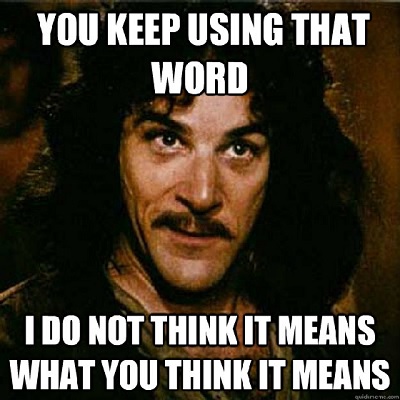
Those of you who were correctly raised will remember watching the Princess Bride (if truly correctly then many times), a movie that despite all of its ridiculousness is one of the most classic fantasy love tales ever told. You may also recall how Vizzini the scheming kidnapper keeps describing situations involving the witty hero Westley that are happening before his eyes as ‘inconceivable’. Eventually the honourable and loveable Inigo Montoya eventually says ‘You keep using that word. I do not think it means what you think it means.’ Ah how classic, such a fun movie, but oh what a great little way to summarize how people use the word love. You, yes you, and probably you too, keep using the word 'love'. But I do not think it means what you think it means.
Everybody knows the two greatest commandments succinctly summarized by Jesus in the gospel of Matthew 22:34-40 :

34 Hearing that Jesus had silenced the Sadducees, the Pharisees got together.  35 One of them, an expert in the law, tested him with this question:  36 ‘Teacher, which is the greatest commandment in the Law?’ 37 Jesus replied: ‘“Love the Lord your God with all your heart and with all your soul and with all your mind.” 38 This is the first and greatest commandment.  39 And the second is like it: “Love your neighbour as yourself.”  40 All the Law and the Prophets hang on these two commandments.’”
These commands are the summary of the law and prophets, the central aims of the great commands of the Old and New Testaments, the first principles that are to guide the Christian life and dictate all that we do. They are the greatest commandments in the Bible, and to love God and our fellow human beings are the greatest things that any person can do. But I do not think it means what you think it means.

Let me describe a situation (this is a hypothetical situation that may or may not be based on real life events): Two or more people are having a discussion about theology, in person, or on Facebook, at church, or some other venue. One person holds to the prosperity gospel and is defending theirs and their church’s teaching of this particular theology. In fact they are part of a massive church, filled with lots of energy and people and other cool stuff. This first guy actually believes the prosperity gospel. The second guy says to him, straight up and honestly, that what he believes is heresy, the prosperity gospel is wrong, it’s been condemned throughout church history consistently. He then proceeds to explain the biblical idea of suffering, and hardship and poverty that is evident in the scriptures and experienced by the greatest of the Apostles, and Jesus. He is not saying Christians can’t prosper, some do, greatly, but simply that prosperity is not everyone’s guaranteed experience as a Christian, in fact the opposite is often true. Therefore the prosperity teaching is sinful. Someone jumps in and says, ‘That’s judgemental, and unloving.’ Someone else pipes up, ‘It may be true, but it’s not loving to call that person’s belief heresy.’ Another person unhelpfully quips, ‘Why can’t we just love each other and get along, no one’s doctrine is perfect. Focus on the log in your own eye. Doctrine divides, love brings us together.’ And finally someone else joins in, ‘I don’t think public forums are the place for such discussions, no matter what is true.’ Ah love…again I say, ‘You keep using that word. I do not think it means what you think it means.’

The problem is that so many people distinguish between truth and love, as though they were polar opposites which is bad enough, but even worse is that a lot of Christians don’t even know half of what the Bible says about love. We are told in Scripture to reason with people, bring them back from error, and confront falsehood, and we are told that this is a big part of showing love.

Behold (that's meant to be read as slightly dramatic) some verses:

17 You shall not hate your brother in your heart, but you shall reason frankly with your neighbor, lest you incur sin because of him. 18 You shall not take vengeance or bear a grudge against the sons of your own people, but you shall love your neighbor as yourself: I am the Lord. (Leviticus 19:17-18  ESV)
It’s amazing how the Bible makes our more stupid arguments look well…stupid (I know this from experience. I have had it happen to me too. It’s why we submit to God’s word, not the other way around. None of us are perfect and the Bible confronts us all). The VERY FIRST TIME ‘love your neighbour’ is found in the Bible, it is in the context of reasoning with them, to show them their error or sin. In fact Moses begins by stating that we should not hate our brother in our heart. In other words, do not keep your disagreement to yourself and dwell on it as you may sin and hate your brother in your heart. We all know the negative effects of holding stuff in which needs to be said. Instead we should reason, frankly. The NIV and KJV are even stronger, they both say rebuke. In this way, by frank reasoning, we love our neighbour as our self. So confronting someone in error or sin is intrinsic to the very first mention in the Bible of loving your neighbour as yourself. Indeed whenever this verse is mentioned in the New Testament, whether by Jesus, or the Apostles, they are quoting this passage. So again, you use the word ‘love’, but I do not think it means what you think it means.   
Indeed in the context of encouraging people to love others above all else, look how Peter expands on it:
8 Above all, keep loving one another earnestly, since love covers a multitude of sins. 9 Show hospitality to one another without grumbling. 10 As each has received a gift, use it to serve one another, as good stewards of God's varied grace: 11 whoever speaks, as one who speaks oracles of God… (1 Peter 4:8-11, ESV).
In other words in the context of loving one another comes the encouragement to speak the very oracles of God. So we who speak should boldly, confidently, respectfully and with conviction speak the truth; this is loving. This means as the Apostles themselves did. They rebuked people, corrected people, encouraged people, and they did these things in public and private, in letters and from public platforms. Paul told the Athenians, in Athens their home ground, in their discussion area, to repent. This is loving and truthful.

Yes indeed we are commanded to speak the truth in love (Ephesians 4:15), but to do this we need to speak. Again let’s bring up the context:
14 so that we may no longer be children, tossed to and fro by the waves and carried about by every wind of doctrine, by human cunning, by craftiness in deceitful schemes. 15 Rather, speaking the truth in love, we are to grow up in every way into him who is the head, into Christ… (Ephesians 4:15, ESV).   
Isn’t that fascinating…the idea of speaking the truth in love, is mentioned in the context of avoiding false doctrine or ‘every wind of doctrine’, meaning doctrine that moves like jelly in the hands of a toddler. No we must not be carried along by untruths, human cunning (in other words human inventions that masquerade as biblical teaching, aka a lot of what is heard from a lot pulpits), but speaking the truth in love, we are to grow up and be like Jesus. In other words speaking the truth in love is what Jesus did and as we do that we display his image in the world.

Now, remember there were times when what Jesus said was just mean, but he was always loving, sometimes we need a metaphorical slap in the face (I know I do, I’m not perfect, no one is), even a public one, to be protected from the dangers of false teaching, which is a serious problem, and mentioned in nearly every New Testament book as something to be wary of. Let’s take a look at Jesus speaking the truth in love in one particular PUBLIC context, where he is challenging false practices:
27 Woe to you, scribes and Pharisees, hypocrites! For you are like whitewashed tombs, which outwardly appear beautiful, but within are full of dead people's bones and all uncleanness. 28 So you also outwardly appear righteous to others, but within you are full of hypocrisy and lawlessness. (Matthew 23:27-28, ESV).
Ouch! Now Jesus said this, and it would have been the gravest of insults to the Pharisees and scribes, and where did he say it?Then Jesus said to the crowds and to his disciples…” (Matthew 23:1, ESV). He said it in public? But..but that's...inconceivable. It’s not for no reason the religious leaders hated him, and killed him. This was mean, but it was true, abundantly true, and it was divisive, confrontational…and incredibly loving because he wanted to bring them to repentance. I’m not saying Jesus was always like this, or that we need to always be like this, or even that in our fallen-ness we will do this very well. I’m simply saying Jesus is God, God is love, Jesus said this and it was the truth being spoken in love. Again, ‘You keep using that word. I do not think it means what you think it means.’
Look so much more can be said about love. We could talk about how it includes humbleness, self-sacrifice, service, sometimes, even often, being silent and just walking with someone and so much more. It especially includes the great love Jesus displayed on the cross, dying for our sins. Libraries of books could be and have been written on love. But our post-modern, post-Christian, post-truth, politically correct world needs to hear this, especially Christians who are caving in to all these things. There appears to be no place for boldness in the church today, at least boldness in calling a spade a spade. Even if it is done in a restrained and careful way, based on indisputable facts, and exercised respectfully, so many in our modern culture just can’t handle it. I think the key to public debate is respect and integrity. But for a lot of people it is niceness, not being divisive, and not offending. But then 90% of topics become taboo and the public space is filled with cat videos and useless platitudes about inane topics. Effectively it's political correctness stamping down on dissent because it makes people uncomfortable.

Now confronting discussions should not be all we do, there is so much depth and richness to the Christian walk, but it should not be excluded, or jumped on by very nice, polite, never want to offend, people whenever it happens either. To quote Solomon, “For everything there is a season, and a time for every matter under heaven: “a time to break down, and a time to build up…a time to cast away stones, and a time to gather stones together; a time to embrace, and a time to refrain from embracing… a time to keep silence, and a time to speak…” (Ecclesiastes 3:3,5,7 ESV).

I trust and really do hope that I have expanded your idea of the biblical view of love. Let it not be said of you, or me, that ‘Love, you keep using this word. I do not think it means what you think it means.’


Monday, 6 April 2015

May Heretics Live Free From Harm


Balthasar Hubmaier (1480-1528), Concerning Heretics and Those Who Burn Them (1524)

Quick Introduction: Hubmaier was one of the early leaders of what would quickly become known as the Ana-Baptist movement, which was an off shoot of the reformation. What makes this guy so significant is that he wrote one of the earliest pleas for religious toleration that we have to date. In this short disputation he argues that those who burn heretics, are in reality heretics themselves. Because he was one of the key leaders in a 16th movement that believed in the separation of church and state, and that everyone should be able to choose their own religion, in a time when the state and church were intricately connected, and chose the state religion for everybody else, the way his life ended was one of terrible irony: he was burned at the stake in March 1528. But his legacy lives on. We take religious freedom for granted in the west, but in fact, we have religious freedom in the west, because of men like Hubmaier, who took Jesus’ teaching literally, when Jesus said don’t pull out the tares with the wheat, and that Jesus did not come to condemn, but to save.  

Here is his brilliant line of reasoning on why it is heretical to kill or persecute the heretic:   

 1. Heretics are those who wickedly oppose the holy scriptures, the first of whom was the devil, when he said to Eve, "Ye shall not surely die", (genesis 3:4) together with his followers.

 2. Those also are heretics that cast a veil over the scriptures and interpret them otherwise than the holy spirit demands; as those who everywhere proclaim a concubine as a benefice, pastoring and ruling the church at Rome, and compelling us to believe this talk.

 3. Those who are such one should overcome with holy knowledge, not angrily but softly, although the Holy Scriptures contain wrath.

 4. But this wrath of the scriptures is truly a spiritual fire and zeal of love, not burning without the Word of God.

 5. If they will not be taught by strong proofs or evangelic reasons, then let them be, and leave them to rage and be mad (Titus 3:2,3), that those who are filthy may become more filthy still (Rev. 22:11).

 6. The law that condemns heretics to the fire builds up both Zion in blood and Jerusalem in wickedness.

 7. Therefore will they be taken away in sighs, for the judgments of God (whose right it is to judge) either convert or harden them, that the blind lead the blind and both the seduced and the seducer go from bad to worse.

 8. This is the will of Christ who said, “Let both grow together till the harvest, lest while ye gather up the tares ye root up also the wheat with them” (Matt. 13:29). “For there must also be heresies among you, that they that are approved may be made manifest among you” (1 Cor. 11:19).

  9. Though they indeed experience this, yet they are not put away until Christ shall say to the reapers, “Gather first the tares and bind them in bundles to burn them” (Matt. 13:30).

 10. This word does not teach us idleness but strife; for we should unceasingly contend, not with men but with their godless doctrine.

 11. The unwatchful bishops are the cause of the heresies. “When men slept, the enemy came” (Matt. 13:25).

 12. Again, “Blessed is the man who is a watcher at the door of the bridegroom’s chamber” (Prov. 8:34), and neither sleeps nor “sits in the seat of the scornful” (Ps. 1:1).

 13. Hence it follows that the inquisitors are the greatest heretics of all, since, against the doctrine and example of Christ, they condemn heretics to fire, and before the time of harvest root up the wheat with the tares.

 14. For Christ did not come to butcher, destroy, and burn, but that those that live might live more abundantly (John 10:10).

 15. We should pray and hope for repentance, as long as man lives in this misery.

 16. A turk or a heretic is not convinced by our act, either with the sword or with fire, but only with patience and prayer; and so we should await with patience the judgment of God.

 17. If we do otherwise, God will treat our sword as stubble, and burning fire as mockery (Job 41:29).

 18. So unholy and far off from evangelical doctrine is the whole order of preaching friars (of which variegated birds our Antony is one), that hitherto out of them alone the inquisitors have come.

 19. If these only knew of what spirit they ought to be, they would not so shamelessly pervert God’s Word, nor so often cry, “To the fire, to the fire!” (Luke 9:54-56).

 20. It is no excuse (as they charter) that they give over the wicked to the secular power, for he who thus gives over sins more deeply (John 19:11).

  21. For each Christian has a sword against the wicked, which is the Word of God (Eph. 6:17), but not a sword against the malignant.

 22. The secular power rightly and properly puts to death the criminals who injure the bodies of the defenseless (Rom. 13:3,4). But he who is God’s cannot injure anyone, unless he first deserts the gospel.

23. Christ has shown us this clearly, saying, “Fear not them that kill the body” (Matt. 10:28).

24. The [secular] power judges criminals, but not the godless who cannot injure either body or soul, but rather are a benefit; therefore God can in wisdom draw good from evil.

25. Faith which flows from the gospel fountain lives only in contests, and the rougher they become so much the greater becomes faith.

26. That everyone has not been taught the gospel truth is due to the bishops no less than to the common people – these that they have not cared for a better shepherd, the former that they have not performed their office properly.

27. If the blind lead the blind, according to the judgment of God, they both fall together into the ditch (Matt. 15:14).

28. Hence to burn heretics is in appearance to profess Christ (Titus 1:10,11), but in reality to deny him, and to be more monstrous than Jehoiakim, the King of Judah (Jer. 37:23).

29. If it is blasphemy to destroy a heretic, how much more is it to burn to ashes a faithful herald of the Word of God, unconvicted, not arraigned by the truth.

30. The greatest deception of the people is a zeal for God that is unscripturally expended, the salvation of the soul, honor of the church, love of truth, good intention, use or custom, episcopal decrees, the teaching of the reason that come by natural light. For they are deadly arrows where they are not led and directed by the Scriptures.

31. We should not presume, led away by the deception of our own purpose, to do better or more securely than God has spoken by his own mouth.

32. Those who rely on their good intention and think to do better, are like Uzziah and Peter. The latter was called Satan by Christ (Matt. 16:23), but the former came to a wretched end (1 Chr. 13:10).

33. Elnathan, Delaiah, and Gemariah acted wisely in withstanding Jehoiakim, the kind of Judah, when he cast the book of Jehovah into the fire (Jer. 35:25).

34. But in that, after one book was burnt, Baruch by the express direction of Jeremiah, wrote another much better (Jer. 36:27-32), we see the just punishment of God on the unrighteous burning. For so it shall be that on those who fear the frost, a cold snow falls (Job. 6:16).

35. But we do not hold that it was unchristian to burn their numerous books of incantations, as the fact in the Acts of the Apostles shows (Acts 19:19). It is a small thing to burn innocent paper, but to point out an error and to disprove it by Scripture, that is art.

36. Now it is clear to everyone, even the blind, that a law to burn heretics is an invention of the devil. “Truth is immortal.”